



Phonics
At New Moston Primary School, we believe that learning to read is one of the most important foundations for a child's education. Being able to read confidently and fluently enables children to access the wider curriculum, develop their independence and discover a lifelong love of reading.
We are committed to ensuring that every child becomes a reader. Through high-quality phonics teaching, regular assessment, targeted support and strong partnerships with our families, we aim to give every child the best possible start to their reading journey.
Our Phonics Curriculum – Read Write Inc.
At New Moston, we follow Read Write Inc. (RWI) Phonics, a systematic synthetic phonics programme developed by Ruth Miskin.
The programme provides a structured and progressive approach to teaching children how to read and spell. Children learn to recognise sounds, blend sounds together to read words and apply their developing phonics knowledge when reading books.
Through Read Write Inc., children learn to:
-
Recognise and recall sounds with increasing automaticity.
-
Blend sounds together to read unfamiliar words.
-
Recognise and read common exception words.
-
Read accurately, fluently and with increasing confidence.
-
Segment words into sounds to support spelling.
-
Develop their vocabulary and understanding of texts.

How We Teach Phonics
Phonics is a fundamental part of our curriculum in Reception and Key Stage 1. Children receive daily phonics teaching that is matched to their current stage of reading development.
Children progress through three sets of sounds:
|
Stage |
Focus |
Examples |
|---|---|---|
|
Set 1 |
Initial sounds and early blending |
m, a, s, d, t, sh, ch |
|
Set 2 |
Developing knowledge of further sounds |
ay, ee, igh, ow, oo |
|
Set 3 |
Alternative ways of representing sounds |
ea, oi, a-e, i-e, o-e |
As children develop their phonics knowledge, they apply their learning through carefully matched reading books. This provides opportunities to practise known sounds, develop fluency and experience success as independent readers.

Assessment and Additional Support
Children's phonics development is regularly assessed to ensure that teaching is appropriately matched to their individual needs.
Where children require additional support, we aim to identify this quickly and provide targeted opportunities to practise and consolidate their learning.
Children who have not yet secured the phonics knowledge needed to read independently continue to receive appropriate phonics teaching beyond Key Stage 1.
The Year 1 Phonics Screening Check
During the summer term, children in Year 1 complete the national Phonics Screening Check.
The check assesses children's ability to apply their phonics knowledge when reading 40 words, including real words and unfamiliar pseudo-words, sometimes referred to as 'alien words'.
Children who do not meet the expected standard in Year 1 receive further support and complete the check again in Year 2.
We work closely with families to help them understand the check, their child's progress and how they can support their child's development at home.
Working Together – Our Phonics Family Offer
Learning to read is a journey we take together.
At New Moston, we recognise the important role that parents and carers play in developing children's reading skills. We want every family to feel confident, informed and equipped to support their child's phonics development.
We are proud to provide a range of opportunities throughout the school year for families to engage with our phonics curriculum, experience our teaching approaches and celebrate their children's reading achievements.
Year 1 Phonics Workshop
Our Year 1 phonics workshop helps parents and carers understand how phonics is taught, the expectations for Year 1, the Phonics Screening Check and practical strategies to support reading at home.
Year 2 Phonics Workshop
Our Year 2 workshop supports families in understanding the next stages of phonics development, with a focus on consolidating knowledge, addressing gaps and developing confident, fluent readers.
Phonics in Action – Modelled Lessons
Parents and carers have opportunities to experience a phonics lesson modelled by our Phonics Lead. These sessions bring our teaching approaches to life and help families understand the routines, language and strategies we use in school.
Wednesday Phonics Club
Our Wednesday after-school phonics club provides additional opportunities for children to practise their phonics knowledge, strengthen their reading skills and develop their confidence through engaging activities.
Our Phonics Picnics
Our special phonics picnics bring children and their families together to celebrate reading. Selected children are invited to attend a special picnic alongside a parent, carer or special adult, sharing positive reading experiences and enjoying learning together.
Through these opportunities, we aim to strengthen the connection between home and school, celebrate children's progress and ensure that families feel part of their child's reading journey.
Supporting Phonics at Home
Small amounts of regular practice can make a significant difference to your child's reading development.
You can support your child at home by:
-
Practising the sounds your child has already learnt.
-
Using pure sounds rather than adding an extra 'uh' sound.
-
Encouraging your child to sound out and blend unfamiliar words.
-
Listening to your child read every day.
-
Encouraging your child to reread familiar books to develop fluency.
-
Reading stories together for enjoyment.
-
Celebrating effort, progress and achievement.
Understanding Our Phonics Language
Children may use some of the following words and phrases when talking about phonics at home.
|
Phonics terminology |
What does it mean? |
|---|---|
|
Speed Sounds |
The sounds children learn to recognise and recall quickly. |
|
Fred Talk |
Saying the individual sounds in a word before blending them together. |
|
Fred in Your Head |
Blending sounds silently before saying the whole word. |
|
Fred Fingers |
Using fingers to identify the individual sounds in a word to support spelling. |
|
Special Friends |
Two or more letters that work together to represent one sound. |
|
Green Words |
Words children can read using their phonics knowledge. |
|
Red Words |
Words containing unusual spelling patterns that children need to learn. |
|
Pure Sounds |
Pronouncing sounds clearly without adding unnecessary sounds. |
Helpful Resources for Parents and Carers
The following resources provide further information and practical guidance to support your child's reading development at home.
The official Read Write Inc. parent and carer resource area also includes sound pronunciation videos, Fred games and downloadable practice materials.
Our Reading and Phonics Hub
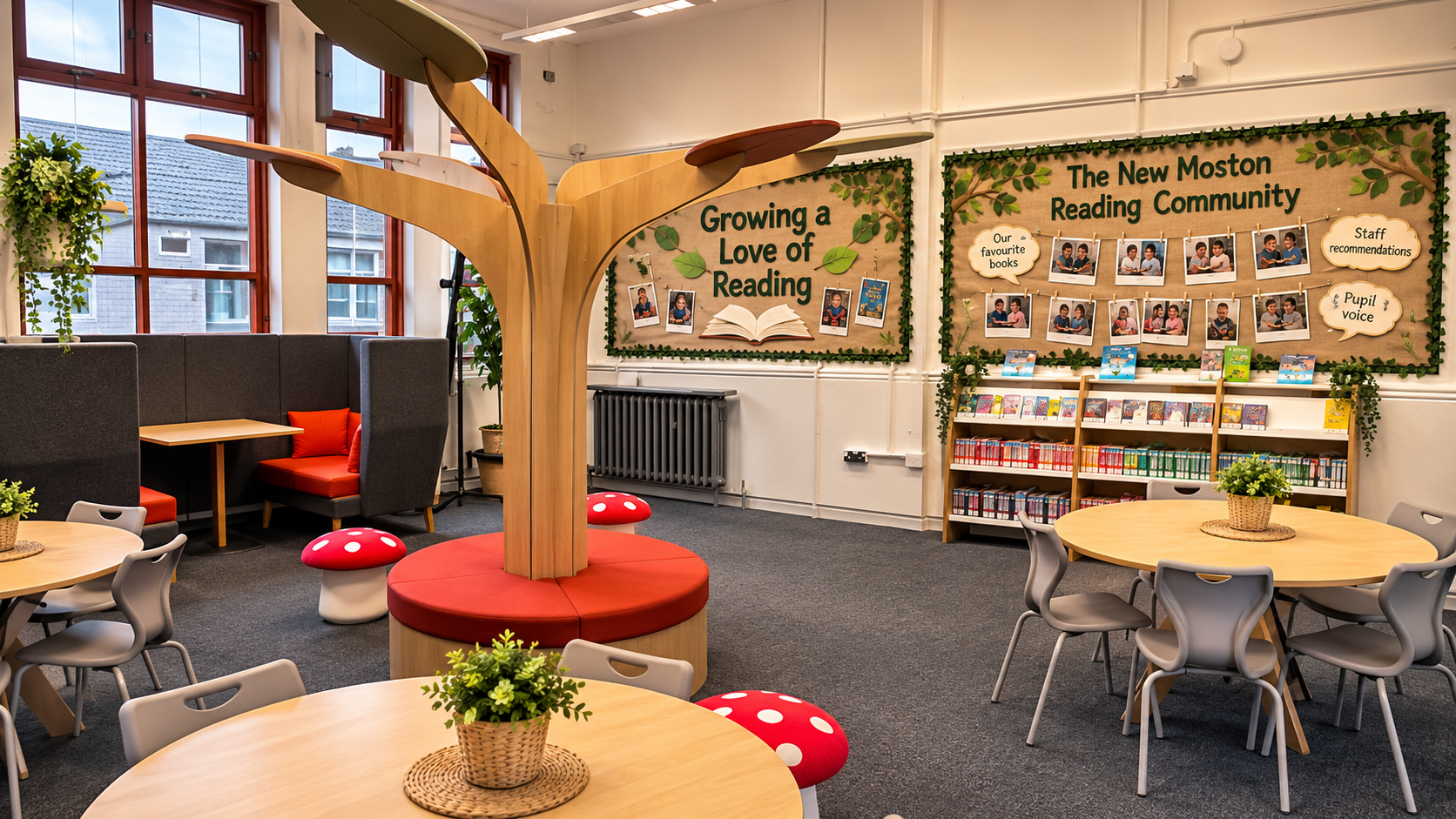
Our dedicated Reading and Phonics Hub reflects our commitment to developing confident readers across New Moston. The space brings together resources that support the delivery of our early reading curriculum and wider reading strategy.
Our investment in reading resources ensures that reading remains a central part of our school improvement journey.
Further Information
If you would like further information about our phonics curriculum, your child's progress or any of our family learning opportunities, please speak to your child's class teacher or contact our Phonics Lead through the school office.
Together, we can help every child become a confident reader.